What's Trending: The Age of Over-Explaining

We’re in an era of over-explaining. People post something, and the moment there’s a negative comment, they come back with a full explanation. A justification. A breakdown of what they meant, what they didn’t mean, who they are, why they did it.
And I understand it. But I also think it reveals something deeper about where we are culturally. We are living in the age of mass opinion.
There was a time when opinion had expert credibility. It was delivered by a trained journalist, vetted by an editor, and published by an institution with a reputation to protect. Opinion had form.
We are living in the era of mass opinion, and unlike any civilisation before us, mass opinion now has a platform, an algorithm, a global audience, and zero editorial filter. Before this moment in history, opinion of consequence came through structure. It had weight because it had context.
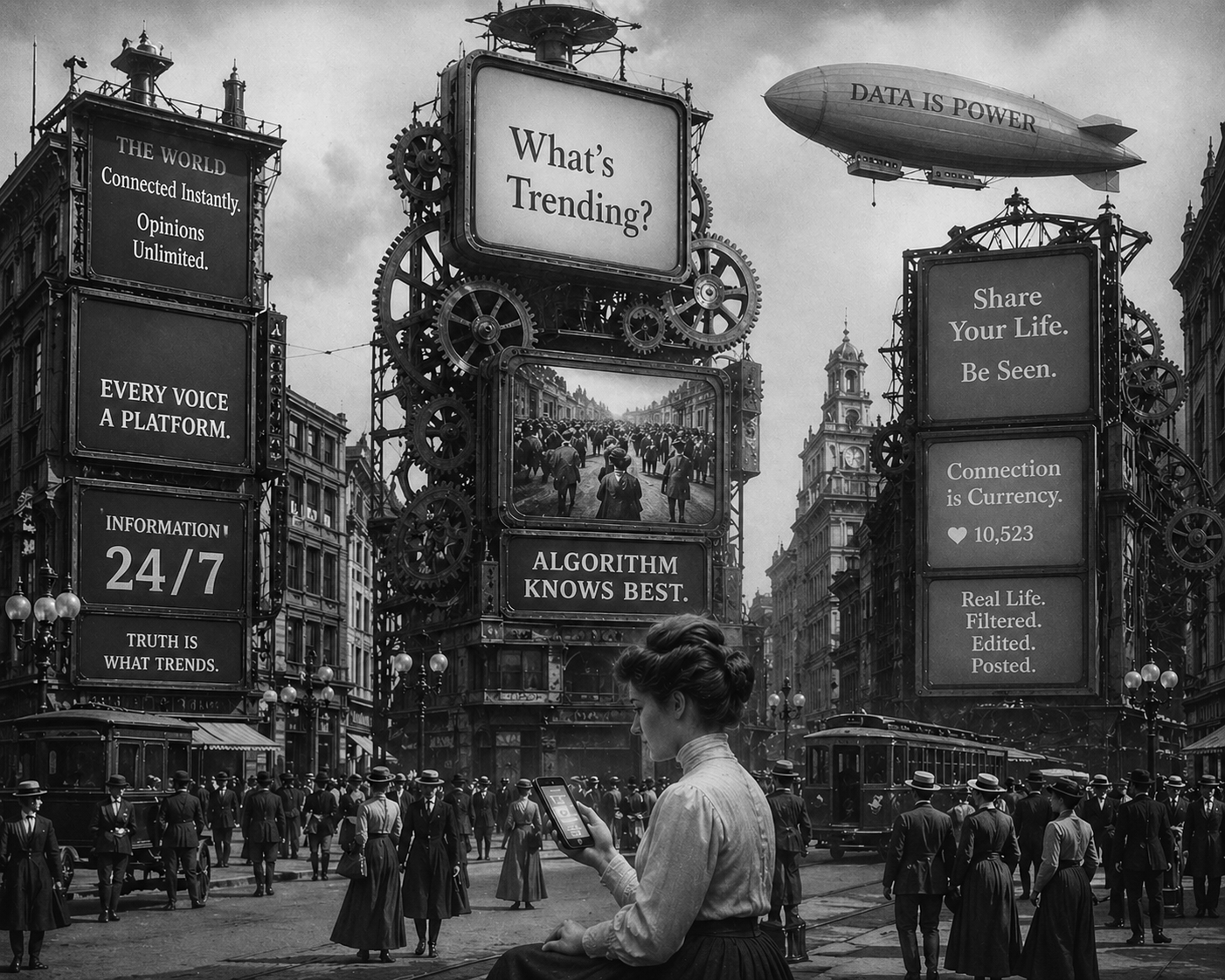
Today, everyone has a microphone. Everyone has something to say. And the noise is deafening, not because people are sharing and saying more.
But not everyone has a grounded identity. And that changes everything. Because when identity is clear, you don’t feel the need to explain yourself to every passing interpretation.
You understand that people are responding to a moment, not the whole of you. Because over-explaining and harsh judgment come from the same place: insecurity.
What I’m seeing is not just oversharing and over-judging. It’s a deeper cultural pattern. A kind of ungroundedness. If you look at history, every powerful era had a signature identity.
The Renaissance was about human potential and beauty.
The Enlightenment was about reason and intellect.
The Industrial Age was about production and power.
Modernism was about reinvention.
There was a clear philosophical backbone that still required us to think, strategize, research, and plan for ourselves. A clear aesthetic. A clear way of being. Today, we have access to everything, but we are anchored in nothing. We are experiencing a split between algorithms and analog (artificial and authenticity).
We have reduced identity to an aesthetic. And what we access is not only shaped by what we share, but by what we are shown by the algorithm. This creates a quiet dissonance. We are still trying to find our way—our own voice. So we remix. We repurpose. We recycle. At scale. But there is no singular narrative, no depth, holding it all together.
When there’s no rooted and shared identity, people try to create one in real time. Through opinions. Through reactions.
So we end up in this loop:
Explaining to be understood.
Reacting to be seen.
Commenting to feel anchored.
But the truth is, the more grounded you are in who you are, the less you need to explain yourself.
Not everything requires a response.
Not every opinion requires engagement.
Not every misunderstanding needs correction.
Sometimes, identity speaks louder in silence. And perhaps the real work of this generation is not to say more… but be committed to protecting the one signature quality of every human that AI and algorithms cannot replace: our sovereignty.